Why VR works for medical education
Evidence, answers to common questions and reading for educators exploring immersive learning.
VR-trained learners perform better
Randomized controlled trials comparing VR training with traditional study materials show clear gains in procedural performance.
Higher procedure completion — 78% of learners trained in VR completed an intramedullary tibial nail procedure, versus 25% with a traditional PDF guide.Orland et al., randomized controlled trial of VR training for intramedullary tibial nailing.
of VR-trained participants improved their overall assessment score between training phases, compared with 22% of those using a surgical technique guide, in a randomized trial on tibial shaft fracture nailing.Blumstein et al., Journal of Surgical Education, 2020.
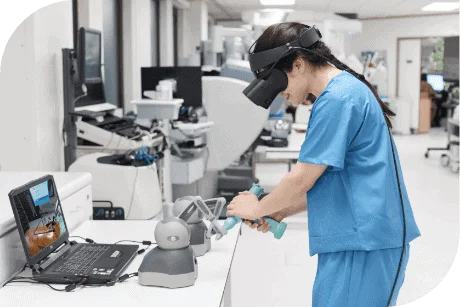
What immersive learning changes
Patient safety
Students make their first mistakes in simulation, not with real patients.
Unlimited repetition
Practise a procedure as many times as needed, without consumables or lab bookings.
Access anywhere
Remote and international students join the same class from wherever they are.
Questions from educators
What hardware do students need?
The campus is built for Meta Quest VR headsets. Students can also join from a desktop computer, which makes it easy to include everyone in a class.
Can teachers and students be in the same session?
Yes. The campus is multiplayer: teachers and students appear as avatars in the same rooms and can talk to each other with spatial voice.
Does it replace our anatomy lab or simulation centre?
It is designed to complement them. Students can prepare and repeat practice in VR, so time in physical labs and with patients is used more effectively.
Can the content follow our curriculum?
Yes. We build new training modules, procedures and branded spaces together with your faculty.
How do we get started?
Book a demo with our team. We then plan a pilot with one class and expand from there.
Is the platform available now?
Our working prototype is ready and we are onboarding pilot partners. Contact us to join the pilot programme.
Further reading
Why VR is changing how medical students learn anatomy
How immersive 3D exploration complements the dissection hall.Clinical simulationSimulation before patients: rehearsing procedures in VR
Where VR rehearsal fits into clinical learning.GuideHow to run a VR pilot at your medical school
A practical checklist for your first pilot.Shape the future of medical education with us
Whether you lead a medical school or want to invest in immersive health education, we’d love to talk.