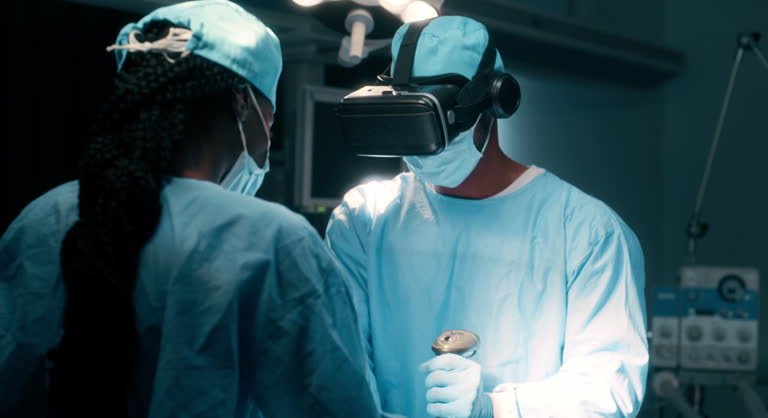
Simulation has been part of medical training for decades, from resuscitation mannequins to high-fidelity simulation suites. Virtual reality builds on that tradition, making rehearsal more accessible, more repeatable and easier to scale to large cohorts.
Why rehearsal matters
Clinical procedures combine knowledge, decision-making and hand movements, often under time pressure. Learners build that combination through practice, and the more realistic the practice, the more transferable it is. Traditionally, that practice has competed for limited time in simulation centres, operating theatres and wards.
What VR adds to simulation
- Step-by-step guidance. A procedure can be broken into stages, with prompts that fade away as the learner becomes more confident.
- Immediate feedback. Learners can see what went right and what went wrong as soon as they finish, rather than waiting for a debrief.
- Repeatable scenarios. The same case can be run again and again, or varied slightly to test judgement.
- Rare and high-risk events. Emergencies that a student may rarely see in real life can be practised safely and on demand.
- Team training. In a multiplayer environment, several learners can rehearse together, practising communication as well as technique.
What the research says
A growing body of research, including randomized controlled trials in orthopaedic and surgical training, has found that learners who prepare with VR tend to perform procedures more completely and accurately than those who prepare with traditional written guides alone. We summarise some of this evidence on our Resources page.
VR rehearsal is most effective when it is connected to real clinical teaching: prepare in VR, practise under supervision, reflect, and repeat.
Designing good VR simulations
The best simulations start with a clear learning objective rather than with the technology. What should the learner be able to do afterwards? Which decisions matter most? Where do students usually go wrong? Working through those questions with clinical faculty is how we design training modules at Kashmeta, from surgical steps to emergency room scenarios.
If your team is exploring VR simulation, we would be glad to share what we have learned and show you our current modules.